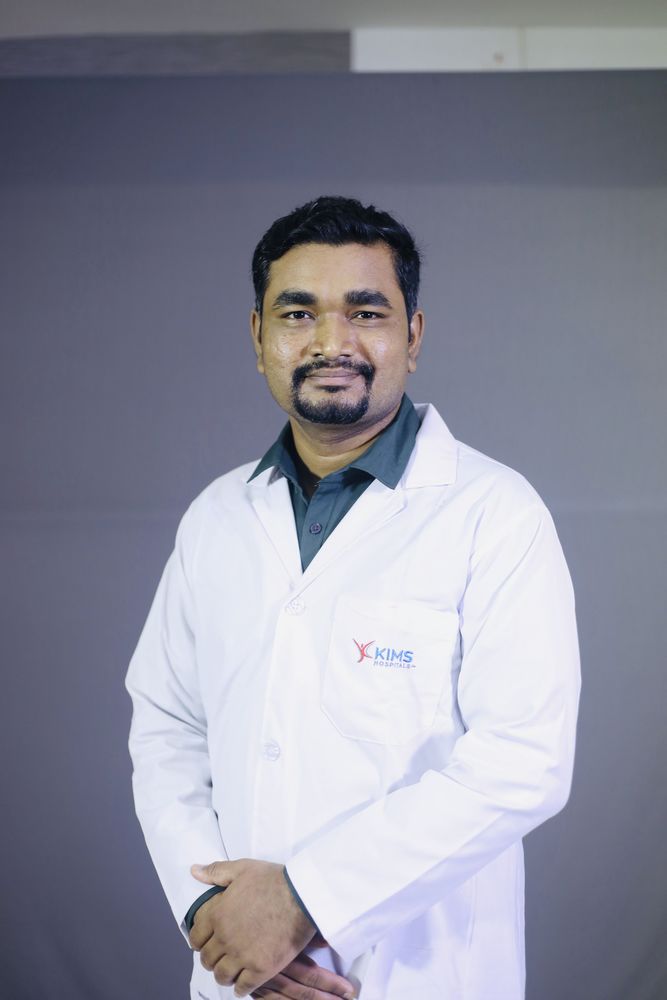
Dr. Manjunath M Negigoudara Transplant Pulmonologist · KIMS Hospital, Electronic City, Bengaluru
Home / Treatments / ECMO at KIMS Electronic City - respiratory critical care
Service · Critical careExtracorporeal Membrane Oxygenation (ECMO) for severe respiratory failure - as bridge to recovery when the lungs will heal, or bridge to transplant when they will not. VV and VA modalities, awake ambulatory protocols, inter-hospital retrieval. Managed by Dr. Manjunath M Negigoudara at KIMS Hospital, Electronic City, Bengaluru.
Extracorporeal Membrane Oxygenation is a temporary heart-lung bypass that takes over gas exchange when the patient’s own lungs cannot. Blood is drained from a large vein, oxygenated by a membrane lung outside the body, warmed, and returned - either to a vein (VV, lung support only) or an artery (VA, combined heart + lung support).
ECMO does not treat the underlying disease. It buys time. The question that defines the case is what we use that time for - waiting for the patient’s own lungs to heal (bridge to recovery), or waiting for a donor lung to arrive (bridge to transplant).
The clinical decision that defines every ECMO case
Bridge to recovery = the underlying lung injury is expected to heal (severe ARDS from pneumonia, influenza, COVID, aspiration). Bridge to transplant = end-stage lung disease has decompensated and the native lungs will not recover. Same machine, two entirely different clinical pathways.
The EOLIA trial (NEJM 2018) - the pivotal randomised trial - showed 60-day mortality of 35% in the ECMO arm vs 46% in conventional ventilation for severe ARDS (relative risk 0.76). Modern international guidance is to consider ECMO in severe ARDS with PaO2/FiO2 ratio below 80 despite optimal ventilation, or severe hypercapnic acidosis unresponsive to protective ventilation.
Typical scenarios:
| Factor | VV ECMO | VA ECMO |
|---|---|---|
| Primary problem | Lung failure only | Combined heart + lung failure, or cardiogenic shock |
| Cannulation | Venous drainage + venous return (femoral + jugular typical) | Venous drainage + arterial return (femoral vein + femoral artery) |
| Cardiac support | None - relies on native heart | Full biventricular support |
| Ambulation feasibility | Good (upper-body cannulation possible) | Limited (femoral arterial cannula anchors patient) |
| Anticoagulation | Lower (ACT 160-180) | Higher (ACT 180-220) |
| Typical use | Severe ARDS, bridge to lung transplant | Cardiogenic shock, primary graft dysfunction post-transplant |
In most lung disease scenarios, VV is the correct choice. VA is reserved for combined cardiac-respiratory failure. The mode can be converted mid-course if clinical condition changes.
A patient lying sedated and ventilated for weeks while waiting for a donor loses muscle mass fast - ICU-acquired weakness sets in within 5-7 days of immobility - and arrives at the operating room markedly weaker than they would be otherwise. The single most important advance in bridge-to-transplant ECMO has been awake mobilisation.
At KIMS Electronic City, patients on ECMO routinely walk the corridor with a physiotherapist, eat meals, communicate with family, and participate in their own care plan. These patients have substantially better post-transplant outcomes - faster extubation, shorter ICU stays, faster rehabilitation.
In practice, the line between bridge-to-recovery and bridge-to-transplant is rarely drawn at the moment of cannulation. Dr. Manjunath M Negigoudara revisits the question at fixed intervals:
For the full clinical framing with EOLIA / JHLT bridge-to-transplant outcomes / Lancet COVID ECMO data, see the pillar guide: ECMO as bridge to recovery vs transplant.
If a patient with severe respiratory failure is too unstable to transport conventionally, the KIMS Electronic City ECMO team can perform inter-hospital retrieval - placing the cannulas at the referring hospital and bringing the patient on ECMO to Bengaluru. This is always higher-risk than initiating ECMO in the receiving ICU.
The single most useful step for referring intensivists: call +91 79937 41199 BEFORE the patient becomes too unstable to transport. Earlier conversations almost always lead to better outcomes. WhatsApp is the fastest channel for sharing imaging and PFT trends.
ECMO adds approximately ₹5-15 lakh to a transplant admission, depending on duration and complications. This is separate from the lung transplant surgical package (₹36 lakh) and pre-transplant evaluation (₹4.5-6 lakh). Full cost breakdown + insurance mechanics + financing playbook: lung transplant cost in India + financing guide.
Referring physicians: call before the patient becomes unstable. Records can be reviewed remotely.
Families: if your relative is on ventilator support at another hospital and the team is considering ECMO, WhatsApp Dr. Manjunath M Negigoudara with the current imaging and blood gases - a same-day second opinion is often possible.
Call +91 79937 41199 · WhatsApp · Book online. Also see: best lung transplant doctor in Bangalore, transplant pulmonologist in Bangalore.