
A pulmonary embolism is a blood clot that has travelled to the lungs, and it is one of the conditions most often mistaken for something else. The breathlessness is put down to anxiety, the chest pain to a pulled muscle, the fast heartbeat to stress. In a young adult a few weeks after delivery or a long journey, nobody thinks of a clot until it is serious.
I am Dr. Manjunath M Negigoudara, a Transplant Pulmonologist at KIMS Hospital, Electronic City, Bengaluru. I see pulmonary embolism at both ends of its course: in the emergency setting, and months or years later in patients who are still breathless because the clot never fully cleared. I have written this for World Thrombosis Day, 13 October, which this year focuses on women’s health.
In short
A pulmonary embolism usually starts as a clot in a leg vein that breaks off and lodges in the lungs. The warning signs are sudden breathlessness, sharp chest pain on breathing in, coughing up blood, fainting, and a swollen painful calf. Risk is highest after surgery or a hospital stay, on long journeys, during pregnancy and especially the first six weeks after delivery, and with oestrogen-containing contraception. Treatment is blood thinners for at least three months. About 3% of survivors develop a long-term complication, CTEPH, which is why anyone still breathless three to six months later should be reviewed.
What is a pulmonary embolism?
Most pulmonary embolisms begin as a deep vein thrombosis (DVT), a clot in a deep vein of the leg or pelvis. Part of that clot breaks free, travels through the right side of the heart and lodges in the arteries of the lung. Together, DVT and pulmonary embolism are called venous thromboembolism.
A clot in the lung arteries blocks blood from picking up oxygen and forces the right side of the heart to pump against resistance. A small clot may cause only mild symptoms. A large one can strain the heart enough to cause collapse. The International Society on Thrombosis and Haemostasis estimates that one in four people worldwide die from conditions caused by thrombosis, which includes heart attacks and strokes as well as venous clots.
What are the warning signs of a pulmonary embolism?
- Sudden breathlessness that is new, or out of proportion to what you are doing. This is the commonest symptom.
- Sharp chest pain that is worse when you breathe in or cough.
- A fast heartbeat or palpitations.
- Coughing up blood, even a small streak.
- Fainting, near-fainting or sudden dizziness.
- A swollen, painful calf or thigh on one side, often warm or red. This is the DVT, and it can come before the lung symptoms or with them.
Go to an emergency department now if
Breathlessness comes on suddenly with chest pain, you cough up blood, you faint, or your lips look blue. Do not drive yourself and do not wait to see if it settles. A swollen painful leg on its own needs medical assessment the same day.
Who is at risk of a pulmonary embolism?
A clot forms when blood flows slowly, when the vein wall is injured, or when the blood itself clots more easily. Most pulmonary embolisms follow one of a small number of risk moments.
| Risk moment | What the evidence shows |
|---|---|
| Hospital stay or surgery | Up to 60% of all venous clots occur during a hospital stay or within 90 days of one (ISTH) |
| Pregnancy | About 5 times the risk of women who are not pregnant (MEGA study) |
| First 3 months after delivery | About 60 times the risk, highest in the first 6 weeks (MEGA study) |
| Oestrogen-containing pill | About 6 clots per 10,000 women a year, against 3 in non-users (Danish national study) |
| Long journeys | About 18% higher risk for every extra 2 hours of travel, 26% for air travel (meta-analysis) |
| Cancer, immobility, previous clot | Each raises risk, and a previous clot is one of the strongest predictors of another |
Relative risks describe groups, not individuals. The absolute risk for most people in each group stays low, which is why prevention targets the highest-risk moments.
The travel figures come from studies in Western countries, so they are a guide rather than an exact figure for long Indian train, bus and car journeys. The principle is the same: hours without moving the legs add up.
Why does World Thrombosis Day focus on women this year?
The 2026 campaign, “Every Woman. Every Age. Every Stage.”, highlights how clot risk changes across a woman’s life, and three moments stand out in the evidence.
- The weeks after delivery. In the MEGA study the risk was highest in the first six weeks after childbirth. A large US study found it remains modestly raised until at least 12 weeks, though the absolute risk after six weeks is low. Breathlessness or a swollen leg in the weeks after delivery should never be put down to tiredness without being checked.
- Pregnancy itself. Risk rises throughout pregnancy. Women with a previous clot or a family history should tell their obstetrician early, because preventive treatment may be advised.
- Hormonal contraception. Combined pills containing oestrogen roughly double a small baseline risk, highest in the first year of use. In the Danish national study, progestogen-only pills and hormone-releasing intrauterine devices were not associated with any increased risk, which makes them an option for women at higher risk.
Why is pulmonary embolism often diagnosed late in India?
The best recent Indian data come from the Madras Medical College pulmonary embolism registry, published in 2024. It followed 186 patients at one large public teaching hospital, so it is not a national figure, but its pattern matches what many Indian pulmonologists see.
- Patients were young: 75% were under 50.
- They presented late: on average about six days after their symptoms began.
- Outcomes were serious: 15.6% died in hospital, and 26.7% had died at one year.
Prevention in hospital is also underused. In the Indian arm of the ENDORSE study, covering 2,058 patients in 10 hospitals, more than half of admitted patients were at risk of a venous clot, but only 16.3% of at-risk surgical patients and 19.1% of at-risk medical patients received the recommended preventive treatment. If you or a family member is admitted for surgery or a serious illness, it is reasonable to ask the team whether clot prevention is planned.
How is a pulmonary embolism diagnosed?
The doctor first estimates how likely a clot is, using a structured score such as the Wells score, which weighs symptoms, heart rate, recent surgery or immobility, previous clots, cancer and leg signs.
- If the likelihood is low, a blood test called D-dimer is done. A low clinical score with a negative D-dimer rules out a clot safely: in the original study the negative predictive value was 99.5%, and the approach avoided unnecessary scans.
- If the likelihood is high, or the D-dimer is raised, imaging follows. A CT pulmonary angiogram, a CT scan with contrast dye, is the usual test.
- A ventilation-perfusion (V/Q) scan is an alternative in some patients, and it is the key test later on for the long-term complication described below.
- An echocardiogram and blood tests show whether the clot is straining the heart, which decides how urgent and how aggressive treatment should be.
How is a pulmonary embolism treated?
The 2019 European Society of Cardiology guidelines, written with the European Respiratory Society, group patients by risk: low, intermediate-low, intermediate-high and high. Treatment follows that grouping.
- Blood thinners (anticoagulants) for everyone. The newer tablets, called direct oral anticoagulants, are recommended over warfarin for eligible patients. They are not suitable for everyone, for example during pregnancy, and your doctor will choose.
- At least three months of treatment. All patients are treated for a minimum of three months. Whether to continue longer depends on the cause: a clot with a clear temporary trigger is usually treated for three months, while an unexplained clot or a persisting risk factor often needs longer.
- Clot-dissolving treatment for the most serious cases. Systemic thrombolysis is reserved for high-risk patients whose circulation is unstable, because it carries a real risk of bleeding.
- A review at three to six months. The guidelines recommend this follow-up for every patient, to decide on further treatment and to check for persistent breathlessness.
What is CTEPH, the long-term risk after a clot?
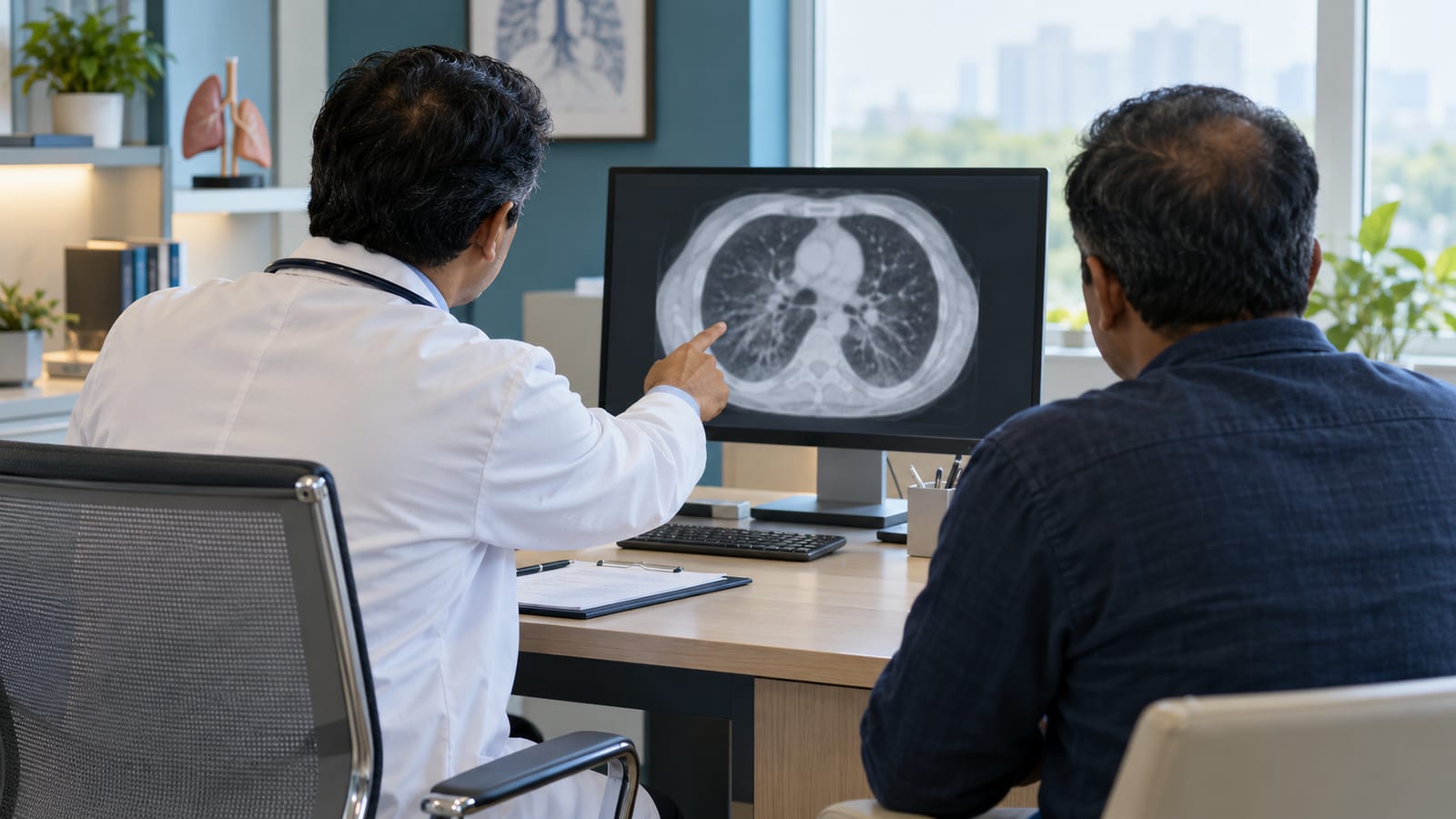
Most clots dissolve on treatment. In a minority, the clot turns into scar-like tissue that stays fixed inside the lung arteries. The narrowed arteries raise the pressure the right side of the heart has to pump against. This is chronic thromboembolic pulmonary hypertension (CTEPH).
- How common: in a landmark study it developed in 3.8% of patients within two years of a pulmonary embolism, with no new cases after two years. A 2017 review of the published studies put it at about 3% of survivors.
- The warning sign: breathlessness on exertion that has not gone away, or is getting worse, three to six months after the clot, despite blood thinners.
- The screening test: a V/Q lung scan. The international task force on CTEPH calls it the screening test of choice, and a normal scan rules CTEPH out. A CT scan alone can miss it.
- The treatment: pulmonary endarterectomy, an operation to remove the scarred material, is the recommended treatment for suitable patients and can be curative. For patients who cannot have surgery there are balloon pulmonary angioplasty at an experienced centre and medicines such as riociguat, which in the CHEST-1 trial improved the six-minute walk distance by 39 metres against a 6-metre fall on placebo. Lifelong anticoagulation is recommended.
CTEPH matters because it is one of the few forms of pulmonary hypertension that can be treated at its cause, and because it is so often missed: the breathlessness is blamed on deconditioning or anxiety after the original illness. The pulmonary hypertension page covers how pulmonary hypertension is assessed at KIMS Electronic City.
Still breathless after a clot?
Persistent breathlessness three months after a pulmonary embolism should be investigated, not accepted
Dr. Manjunath M Negigoudara at KIMS Hospital, Electronic City reviews patients who are still breathless after a pulmonary embolism, with echocardiography and a V/Q scan where CTEPH is suspected, and a clear plan for anticoagulation. Reports can be sent ahead on WhatsApp for a first opinion before you travel.
- Review of the original CT and the course since
- Screening for CTEPH with the right test
- A written plan for how long to continue blood thinners
How can you lower your risk of a blood clot?
- Ask about clot prevention when admitted for surgery or a serious illness, and get moving as soon as you are allowed.
- Move on long journeys. Walk every hour or two where you can, flex your calves while seated, and avoid long stretches without moving, especially if you have other risk factors.
- Tell your doctor about any previous clot, or a family history of clots, before surgery, before starting contraception or hormone therapy, and early in pregnancy.
- Take blood thinners exactly as prescribed and do not stop early because you feel better. Keep the three-to-six-month review appointment.
- Know the warning signs above, and act on them the same day.

For patients from Bangalore, across India, and abroad
A suspected pulmonary embolism needs the nearest emergency department, not a long journey. Where Dr. Manjunath M Negigoudara can help is in the weeks and months afterwards: a second opinion on treatment length, and assessment of patients who remain breathless.
In Bengaluru he consults at KIMS Hospital, Electronic City, Hosur Road, reachable from Silk Board, HSR Layout, Koramangala, Bommanahalli and Sarjapur Road. Patients from elsewhere in India and abroad can start with a remote review: WhatsApp the CT pulmonary angiogram report and images, echocardiogram, any V/Q scan, recent blood tests and the medication list to +91 88670 59997, and plan a visit only if it is needed.
Questions to ask after a pulmonary embolism
- What do you think caused the clot, and was there a clear trigger?
- Which blood thinner am I on, and how long should I take it?
- What should I do if I need surgery, a dental procedure or a long journey while on it?
- When is my three-to-six-month review, and what will be checked?
- If I am still breathless at that review, will I be screened for CTEPH with a V/Q scan?
- Does this change my choice of contraception or plans for pregnancy?
- Should my family members know, in case there is an inherited tendency to clot?
The honest summary
Pulmonary embolism is common, often affects younger people than expected, and in India is often recognised late. The warning signs are clear once you know them, and the highest-risk moments, after surgery, on long journeys, in pregnancy and after delivery, and on oestrogen-containing contraception, are predictable. Treatment works, and the follow-up visit three to six months later is where the one complication that is easy to miss, CTEPH, is caught.
If you have had a pulmonary embolism and are still breathless, Dr. Manjunath M Negigoudara at KIMS Hospital, Electronic City, Bengaluru can review your scans and tell you whether further tests are needed. Send your reports on WhatsApp to +91 88670 59997, or book a consultation.
Frequently asked questions
What are the first warning signs of a pulmonary embolism?
Can young people get a pulmonary embolism?
How long after giving birth is the risk of blood clots highest?
Do contraceptive pills cause blood clots?
Can I get a blood clot from a long flight or bus journey?
How long do you take blood thinners after a pulmonary embolism?
Why am I still breathless months after a pulmonary embolism?
Can I get a pulmonary embolism review without travelling to Bengaluru?
Medical disclaimer. This article is general information from Dr. Manjunath M Negigoudara’s clinical practice. It is not a substitute for an individual consultation. For specific advice about your condition, please schedule a consultation. For emergencies, call 108 (India) or go to your nearest emergency department.
More reading
-
 Patient education · World Hospice & Palliative Care Day Palliative care in pulmonary fibrosis and COPD - living better with advanced lung disease
-
 Patient guide · Transplant access Lung transplant registration in India: how NOTTO listing actually works
-
 Patient education · COPD Lung transplant for COPD in India - does it improve survival, and who benefits?
-
 Patient education · Prognosis Pulmonary fibrosis life expectancy in India - what the numbers mean and what changes them

Next available
Book a consultation with Dr. Manjunath M Negigoudara
In person at KIMS Hospital, Electronic City, or by video