
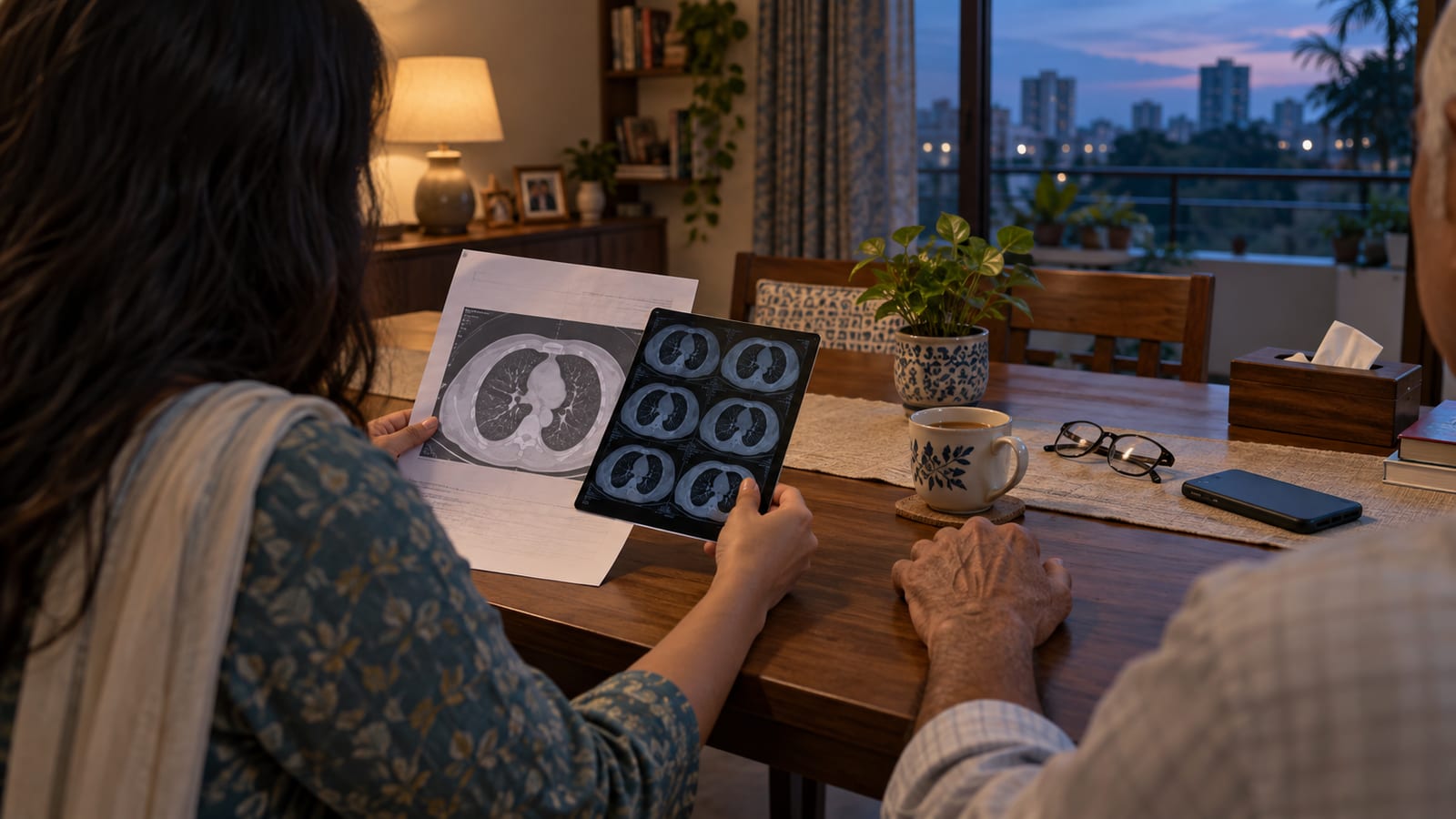
“Pulmonary fibrosis life expectancy” is the search families type on the evening of the diagnosis. The report says fibrosis, the doctor mentions scarring, and the phone comes out in the car park. What comes back is usually a figure from an American patient charity, written for a different health system, drawn from cohorts studied before the drugs we use today existed, and describing one specific disease, idiopathic pulmonary fibrosis, when the report in your hand may be describing another. That figure then sets the mood of the whole household for weeks. It should not.
I am Dr. Manjunath M Negigoudara, a Transplant Pulmonologist at KIMS Hospital, Electronic City, Bengaluru. I run the Advanced Lung Failure and Lung Transplant Clinic as part of one of Asia’s largest thoracic transplant programmes, and I have personally managed 250+ lung transplants. A large share of my clinic is the conversation this article replaces: a family, a report, a number from the internet, and the question “how long”. This is the answer I give, with the evidence it rests on, and the five decisions that change it.
In short
There is no single life expectancy for “pulmonary fibrosis”, because it is several diseases. For idiopathic pulmonary fibrosis, the most aggressive type, older cohorts reported a median survival of roughly 3 to 5 years from diagnosis, and the GAP index separates that into stages with very different risk. The number moves with five things: how early the diagnosis is made, whether an antifibrotic drug is started and continued, whether acute exacerbations are prevented, whether rehabilitation and oxygen are used properly, and whether the transplant conversation happens at the right time. Dr. Manjunath M Negigoudara at KIMS Electronic City stages every fibrosis patient on the first visit and maps those five decisions in writing.
Is life expectancy the right first question?
Not because it is a bad question. Because it is unanswerable until three other questions are answered first, and families skip them.
Which fibrosis? Idiopathic pulmonary fibrosis (IPF) is the one the internet figures describe. It has a specific CT pattern called usual interstitial pneumonia, no identifiable cause, and the steepest course. But in the prospective Indian ILD registry (Singh S and colleagues, 1,084 patients across 27 centres), IPF was a minority of all interstitial lung disease. The commonest diagnosis was hypersensitivity pneumonitis, a reaction to something inhaled at home or at work, which can stabilise or even improve when the exposure is found and removed. Fibrosis from connective tissue disease, from drugs, from sarcoidosis and from old tuberculosis each has its own course. A life expectancy figure for IPF applied to a patient with fibrotic hypersensitivity pneumonitis is simply wrong, and usually wrong in the frightening direction.
Which stage? Two patients with the same diagnosis can have a three-fold difference in one-year risk depending on age, sex and lung function. That is what the GAP index measures, and it is calculated from tests you probably already have.
Which treatment era? The median survival figures most often quoted come from cohorts followed before nintedanib and pirfenidone were available, before pulmonary rehabilitation was standard, and in countries where lung transplantation for fibrosis was rare. Applying them unchanged to a patient starting antifibrotic therapy in Bengaluru in 2026, with a transplant unit in the same building, is a category error.
So the right first questions are: what exactly is the diagnosis, what is my GAP stage, and what is the plan for the next twelve months. Life expectancy follows from those three, and it is partly in your hands.
What is the life expectancy with pulmonary fibrosis?
For IPF specifically, the honest starting point is the GAP index, published by Ley and colleagues in the Annals of Internal Medicine in 2012 and still the most widely used staging tool. It scores four things.
- Gender: female 0 points, male 1 point.
- Age: 60 or under 0 points, 61 to 65 1 point, over 65 2 points.
- FVC (forced vital capacity, the size of your breath on spirometry): above 75% of predicted 0 points, 50 to 75% 1 point, below 50% 2 points.
- DLCO (how well oxygen crosses into the blood): above 55% of predicted 0 points, 36 to 55% 1 point, 35% or below 2 points, unable to perform the test 3 points.
A total of 0 to 3 is Stage I, 4 to 5 is Stage II, 6 to 8 is Stage III. In the cohort the index was built on, the mortality figures by stage were:
| GAP stage | Points | 1-year mortality | 2-year mortality | 3-year mortality |
|---|---|---|---|---|
| Stage I | 0 to 3 | about 6% | about 11% | about 16% |
| Stage II | 4 to 5 | about 16% | about 30% | about 42% |
| Stage III | 6 to 8 | about 39% | about 62% | about 77% |
Source: Ley B et al., Annals of Internal Medicine 2012 (GAP index derivation cohort). These are risks for groups of patients studied before antifibrotic therapy, not predictions for one person.
Read that table the way a clinician reads it. A 58-year-old woman with FVC 78% and DLCO 58% scores 0: Stage I, and her one-year risk in that cohort was in single digits. A 68-year-old man with FVC 48% and DLCO 34% scores 7: Stage III, and the same table says four in ten did not reach one year. Both are “pulmonary fibrosis”. Both would have found the same internet figure. Only one of them should be in a transplant work-up this month.
Two cautions about the table. First, it is a group statistic. It cannot tell one patient what will happen, only which group they resemble. Second, it predates antifibrotic drugs and the modern transplant era, so for a treated patient the true risk is likely lower than the row suggests. It remains the best framework we have for deciding how urgent the next steps are, which is what it was built for.

What changes pulmonary fibrosis life expectancy?
If the GAP table is the map, these are the roads. Each one is a decision, and each one is supported by evidence rather than hope.
- How early the diagnosis is made. The Indian ILD registry found that the interval from first symptom to diagnosis was typically one to two years, with many patients treated for tuberculosis first. Every one of those months is lung capacity lost that no drug returns. A patient diagnosed at Stage I has options that a patient diagnosed at Stage III no longer has.
- Whether an antifibrotic is started and continued. Nintedanib and pirfenidone roughly halve the rate of decline. The benefit is cumulative, which is why stopping and starting, or waiting a year “to see”, costs more than families realise.
- Whether acute exacerbations are prevented. These sudden deteriorations are the single largest cause of death in IPF, and part of the risk is modifiable.
- Whether rehabilitation and oxygen are used properly. Neither changes the scan. Both change how far you can walk, how often you are admitted, and how well you tolerate a transplant if it comes.
- Whether the transplant conversation happens at the right time. For advanced fibrosis, transplantation is the only intervention that replaces scarred lung. Referred early, it is a plan. Referred late, it is a rescue, and rescues have worse outcomes.
The rest of this article takes these one at a time.
Do antifibrotic drugs extend life in pulmonary fibrosis?
The two approved drugs, nintedanib and pirfenidone, were tested in large randomised trials published in the New England Journal of Medicine in 2014. Their primary outcome was the rate of FVC decline over a year, not survival, and it is worth being precise about what they showed.
In the INPULSIS trials, patients on nintedanib lost roughly 110 to 115 millilitres of FVC over the year against roughly 205 to 240 millilitres on placebo, a reduction of about half. In ASCEND, pirfenidone reduced the proportion of patients who had a 10% fall in FVC or died by about 48%. Neither trial on its own proved that patients lived longer. A prespecified pooled analysis of the pirfenidone trials, however, found all-cause mortality at one year reduced by about 48% in relative terms, and the INPULSIS-ON extension study followed nintedanib patients for up to about four years with the slower decline persisting throughout.
The clinical translation is this. The drugs do not reverse scarring and they do not stop the disease. They slow it, consistently, for years, and slowing a progressive disease for years is how you buy time: time in a better GAP stage, time to reach transplant listing while still strong enough to benefit, time in which a grandchild is born. That is the honest description, and it is a good one.
In India both drugs are available as generics, which matters for a treatment that must continue indefinitely. The practical barriers are side effects (diarrhoea with nintedanib, sun sensitivity and nausea with pirfenidone) and the temptation to stop when the patient feels no different, because the drug prevents a decline rather than producing an improvement. My clinic spends as much time on adherence as on choice of drug, because a prescription that lapses after four months has bought almost nothing. The full pulmonary fibrosis guide covers dosing, monitoring and the nintedanib versus pirfenidone decision in detail.

What is an acute exacerbation and why does it matter most?
Ask any transplant pulmonologist what they fear for a fibrosis patient and the answer is not the slow decline. It is the acute exacerbation: a worsening of breathlessness over days rather than months, with new ground-glass change on CT, and no infection, heart failure or clot to explain it. The international working group report by Collard and colleagues in 2016 defined the condition and reported in-hospital mortality of roughly half. Many patients who survive the admission are left with a permanently lower baseline.
Some exacerbations come without warning. Many follow a trigger, and the triggers are where the work is:
- Respiratory infections. Influenza, pneumococcal, COVID-19 and, where indicated, RSV vaccination are not optional extras in fibrosis. They are prognosis-changing.
- Aspiration and reflux. Silent reflux is common in fibrosis and is a recognised trigger. Reflux control, not eating late, and head-of-bed elevation are cheap.
- Procedures and surgery. General anaesthesia and lung biopsy carry exacerbation risk. Any procedure needs the fibrosis team’s input beforehand.
- Air pollution and smoke. Bengaluru winters, festival smoke and construction dust are real exposures. An N95 mask on bad-air days is reasonable.
- Delayed presentation. A patient who calls on day one of worsening has options. A patient who arrives on day five in the emergency department has fewer.
Call the same day if
Breathlessness has clearly worsened over one to three days, resting oxygen saturation has fallen below your usual value, you need more oxygen than usual, or a cough has changed character with fever. Do not wait for the next scheduled visit. In fibrosis, days matter.

Do rehabilitation and oxygen improve survival?
Supervised pulmonary rehabilitation, meaning a structured programme of exercise, breathing training and education, consistently improves walking distance and quality of life in fibrotic lung disease. It also does something the trials do not measure directly: it keeps a patient strong enough to be a transplant candidate. Deconditioning and weight loss are among the commonest reasons an otherwise suitable patient is declined for listing.
Oxygen is prescribed against a measurement, not a feeling. A 6-minute walk test with a pulse oximeter tells us whether saturation falls on exertion and by how much. Patients who desaturate below 88% on walking are given ambulatory oxygen so that they keep walking; the alternative, walking less to avoid breathlessness, is how the spiral of deconditioning starts. Neither rehabilitation nor oxygen adds years on its own. Together they protect the years the other treatments are buying.
When should the numbers trigger a transplant conversation?
This is the section most families read too late. The 2021 International Society for Heart and Lung Transplantation consensus is explicit that referral for fibrosis should happen earlier than most clinicians and patients expect. Referral is a conversation and a work-up. It does not commit anyone to surgery. It ensures that if the disease accelerates, the plan already exists.
ISHLT 2021: refer any patient with pulmonary fibrosis who has any of the following
- A usual interstitial pneumonia pattern on HRCT, regardless of lung function
- FVC below 80% predicted, or DLCO below 40% predicted
- A 10% fall in FVC, or a 15% fall in DLCO, over 6 months
- Oxygen saturation below 88% on exertion, or a 6-minute walk distance under 250 metres
- Any need for supplemental oxygen, at rest or on walking
- Pulmonary hypertension on echocardiogram or right-heart catheterisation
Notice that the first criterion needs no lung function test at all. A UIP pattern on the CT is enough to start the conversation, because IPF is the diagnosis in which time is least forgiving. Notice too that a GAP Stage II patient will usually already meet one of these criteria. That is why I stage on the first visit: the stage tells me whether we are talking about a referral this month or a plan for next year.
What does transplant change? For patients with advanced fibrosis it is the only treatment that replaces scarred lung rather than slowing further scarring. ISHLT registry reports put median survival after adult lung transplantation at about 6.7 years overall, and about 8.9 years for patients who survive the first year, with bilateral transplants doing better than single. Set against the Stage III row of the GAP table, that is not a bending of the curve. It is a different curve. Who is and is not a candidate, and what the year before and after surgery look like, are covered in who needs a lung transplant and life after lung transplant.
In India this option is real and recent. The KIMS Institute of Heart and Lung Transplant, where I practise, has completed 780+ thoracic transplants, and I have personally managed 250+ lung transplants within it. A fibrosis patient at KIMS Electronic City is assessed by the same team that would list and transplant them. Referral is a change of room, not a change of hospital.
If your report says fibrosis
Know your diagnosis and your stage before you accept any number
Dr. Manjunath M Negigoudara at KIMS Hospital, Electronic City stages every pulmonary fibrosis patient on the first visit: HRCT review with an ILD-trained radiologist, PFT with DLCO, 6-minute walk test with oximetry, GAP score, and a written twelve-month plan that states plainly whether transplant referral criteria are already met. Reports can be sent ahead on WhatsApp for a first opinion before you travel.
- Diagnosis confirmed or corrected before treatment starts
- GAP stage and referral criteria explained in writing
- Antifibrotic started with an adherence plan, not just a prescription
- Transplant unit in the same building if and when it is needed

How do you read your own FVC and DLCO reports?
You do not need to calculate your prognosis yourself, but you should be able to find the four numbers that determine it, because they tell you how urgent your next appointment is.
- FVC, percent predicted, on the spirometry or PFT report. Above 80% is the referral threshold on this line; below 50% scores the maximum GAP points. Watch the trend across reports more than any single value: a 10% fall in six months changes management.
- DLCO, percent predicted, on the full PFT report. Often the first number to fall. Below 40% meets ISHLT referral criteria on its own.
- Lowest saturation on the 6-minute walk test, and the distance walked. Below 88%, or under 250 metres, meets referral criteria and usually means ambulatory oxygen is due.
- The HRCT pattern named in the radiologist’s conclusion. “UIP” or “probable UIP” means the referral conversation should already be on the table. “Fibrotic hypersensitivity pneumonitis” or “NSIP” means a different disease with a different course, and the search for a cause matters.
If a report does not contain DLCO, ask for it. Spirometry alone can look reassuring in fibrosis for longer than the disease deserves, and a patient staged on spirometry alone is staged wrongly.
For patients from Bangalore, across India, and abroad
A prognosis conversation should happen with the specialist who will act on it, and the workflow at KIMS Hospital, Electronic City adapts to where the patient is coming from. The clinical reasoning is identical in each case. The logistics differ.
For patients in Bangalore
Dr. Manjunath M Negigoudara consults at KIMS Hospital, Electronic City, Survey No. 37 & 38, PES University EC Campus, Hosur Road, Konappana Agrahara, Bengaluru 560100, about 15 minutes from Silk Board via the elevated expressway and directly reachable from HSR Layout, Koramangala, Jayanagar, JP Nagar, Bommanahalli, Sarjapur Road, Whitefield, Marathahalli and central Bengaluru. HRCT chest, PFT with DLCO and a 6-minute walk test can usually be completed on the day of a first consultation, so the GAP stage is known before you leave the building. Call or WhatsApp +91 79937 41199 to plan the visit. The lung transplant doctor in Bangalore page describes the transplant-side pathway at KIMS.
For patients from other parts of India
Patients travel from across Karnataka (Mysuru, Mangaluru, Hubballi-Dharwad, Belagavi, Kalaburagi, Shivamogga, Tumakuru, Davangere, Ballari), from Tamil Nadu (Chennai, Coimbatore, Madurai, Tiruchirappalli), Andhra Pradesh (Vijayawada, Visakhapatnam, Tirupati, Guntur), Telangana (Hyderabad, Warangal), Kerala (Kochi, Thiruvananthapuram, Kozhikode, Kannur) and Goa, and from further afield: Maharashtra (Mumbai, Pune, Nagpur), Gujarat (Ahmedabad, Surat), Delhi NCR, Kolkata, Bhubaneswar, Guwahati, Chandigarh, Lucknow and the North-East. Kempegowda International Airport is about 45 km from the hospital. The workflow starts with a remote pre-arrival review: WhatsApp the HRCT, the full PFT with DLCO, any 6-minute walk result, the echocardiogram and the medication list to +91 79937 41199. Dr. Manjunath M Negigoudara reviews them personally and replies with a first impression, including the GAP stage where the reports allow it, so that a single visit of one or two days is usually enough for a definitive plan.
For international patients
Families come from the SAARC region (Bangladesh, Nepal, Sri Lanka, Maldives, Bhutan), the Middle East (Oman, UAE, Saudi Arabia, Iraq, Yemen, Kuwait, Bahrain, Qatar), East Africa (Kenya, Tanzania, Ethiopia, Uganda, Rwanda, Sudan), West Africa (Nigeria, Ghana) and Southeast Asia (Myanmar, Indonesia, Malaysia), often because the prognosis they were given at home came with no treatment plan attached. India offers both antifibrotic drugs as generics and, where indicated, lung transplantation at a fraction of Western cost, with high-volume centres reporting outcomes in line with the ISHLT registry. The sequence is: reports on WhatsApp for a written opinion, medical visa support from the hospital’s international patient team, a three to four day evaluation visit, a written plan, and structured video follow-up after return. The written opinion comes first, before any travel is booked, so that nobody flies for a conversation that could have been had by phone.
Questions to ask at your next appointment
Take these to whichever doctor you see. The answers, not the internet, are your prognosis.
- Which type of pulmonary fibrosis do I have, and how confident are you? Has a cause been looked for?
- What is my FVC and DLCO as a percentage of predicted, and what is my GAP stage?
- Do I already meet any ISHLT lung transplant referral criteria? If not, which one am I closest to?
- Should I be on an antifibrotic drug, and if I am, how will we know it is working?
- What is my plan if I get suddenly worse, and whom do I call the same day?
- Which vaccines do I need this year?
- Do I desaturate on walking, and do I need oxygen for exercise?
- When are my lung function tests being repeated, and who compares them with the last set?
A doctor who can answer all eight has given you a prognosis. A search engine cannot.
The honest summary
Pulmonary fibrosis life expectancy is not one number. For idiopathic pulmonary fibrosis, the GAP index turns a frightening average into a specific stage with a specific urgency. Antifibrotic drugs slow the disease by about half, for years, if taken consistently. Acute exacerbations are the main threat and are partly preventable. Rehabilitation and oxygen protect the time the other treatments buy. And for advanced disease, lung transplantation is the only treatment that changes the curve rather than bending it, which is why the referral conversation belongs early.
If your family has just heard the word fibrosis, Dr. Manjunath M Negigoudara at KIMS Hospital, Electronic City, Bengaluru will tell you which disease it is, which stage you are in, and what the next twelve months should look like, in writing. Send your HRCT and PFT reports on WhatsApp to +91 79937 41199 for a first opinion, or book a consultation. The number you are looking for is in your reports, and it is more hopeful than the one on your phone.
Frequently asked questions
What is the life expectancy with pulmonary fibrosis in India?
Is pulmonary fibrosis a terminal illness?
Do nintedanib and pirfenidone increase life expectancy?
What is the GAP index and how do I calculate my stage?
What shortens life the most in pulmonary fibrosis?
When should pulmonary fibrosis be referred for lung transplant?
How long do people live after a lung transplant?
Can I get a second opinion on my pulmonary fibrosis prognosis without travelling to Bengaluru?
Medical disclaimer. This article is general information from Dr. Manjunath M Negigoudara’s clinical practice. It is not a substitute for an individual consultation. For specific advice about your condition, please schedule a consultation. For emergencies, call 108 (India) or go to your nearest emergency department.
Have a question about your case?
Talk directly with Dr. Manjunath M Negigoudara.
Consultations, second opinions and referrals are welcomed by phone or WhatsApp. Mon - Sat, 9am - 5pm at KIMS Electronic City.