Families ask me two questions almost as often as they ask about cost. First: “What is life actually like after a lung transplant?” And second, quieter, usually a few days later: “How long will it last?” Both are fair questions, and both deserve honest, clinical answers. I am Dr. Manjunath M Negigoudara - MBBS, MD (Pulm Med), DNB, FIP - and this article walks through the first year in detail, explains how your transplanted lungs actually work (they are different from your original lungs in important ways), maps the milestones we watch for, and closes with the long-term outlook based on current ISHLT registry data and my practice as a Transplant Pulmonologist at KIMS Hospital, Electronic City, Bengaluru.
In short
Hospital recovery is 14–21 days. Return to normal home life is 3–6 months. The first year is when doses stabilise, surveillance is intensive, and the graft settles. Most recipients return to office work by month 3–4, resume gym-level exercise around month 6, and reach steady-state health by month 12. Global 5-year survival per the ISHLT registry is around 55 % - individual outcomes depend on age, disease, and whether the transplant is single or bilateral.
What “new lungs” actually feel like
The most common thing patients say when they first breathe with donor lungs is not what you might expect. It is not “I can breathe deeply” or “I feel strong.” It is, almost universally: “I am not thinking about my next breath.” For someone who has spent the last two or three years planning every activity around oxygen supply and breathlessness, that absence of effort is what registers first. Everything else - strength, stamina, endurance - comes later, and takes months.
Your new lungs are, in most technical measures, healthier than your original lungs have been in years. But they are also different: denervated (no cough reflex from below the anastomosis), initially fed by only one blood supply, and living inside a body whose immune system is now deliberately dialled down to prevent rejection. Understanding what is different is the foundation of a good long-term recovery.
What happens in the first week after a lung transplant?
The first week sets the trajectory for everything that follows. Time in ICU is the single biggest determinant of both cost and long-term outcome, so our whole team focuses on getting each milestone hit early.
Day 0-1: intensive care, ventilator, chest tubes
You wake up in the isolation ICU. You are on a ventilator, with an arterial line, central venous access, a urinary catheter, chest tubes to drain post-operative fluid and air, and a nasogastric tube for medication and early nutrition. Sedation is titrated so you can respond to commands but stay comfortable. Family visits are strictly time-limited and gowned - the isolation room is a controlled environment to protect the graft from infection during its most vulnerable window.
Day 1-2: extubation
We start weaning ventilator support within hours of surgery. The goal is extubation within 24–48 hours. Patients who come off the ventilator quickly do better on every downstream measure - fewer ventilator-associated infections, faster ICU discharge, shorter total stay, better long-term function. Post-extubation, oxygen is given by high-flow nasal cannula, then gradually stepped down.
Day 2-4: sitting, standing, first steps
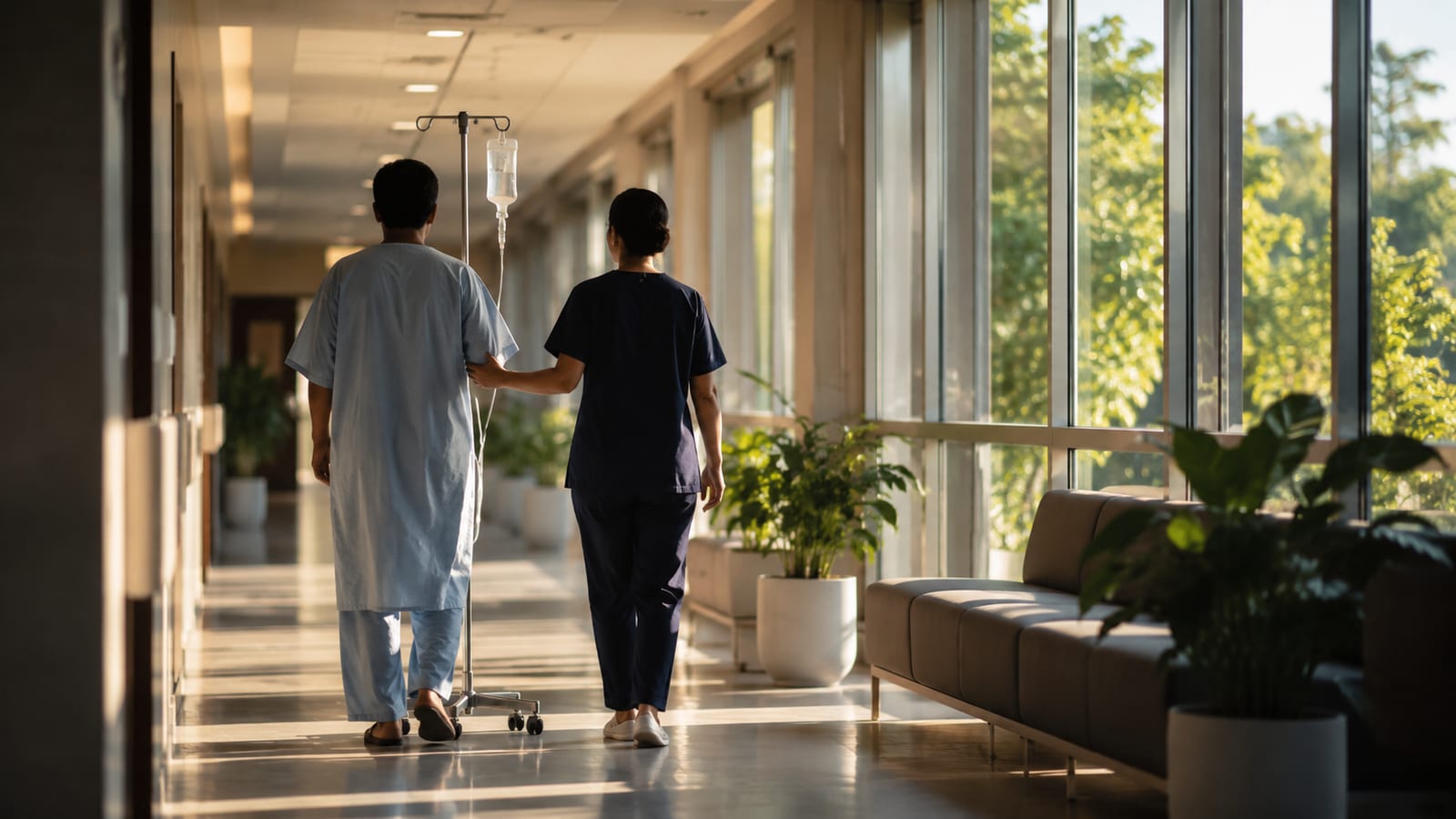
Physiotherapy starts at the bedside on day 2 - controlled breathing exercises, incentive spirometry, and passive-to-active range of motion. By day 3–4, most patients are transferring from bed to chair, then taking the first assisted steps within the ICU corridor. This is not for exercise - it is for lung expansion, clot prevention, and psychological momentum. Patients who are up and moving by day 4 have a very different trajectory than those who remain bedbound.
Day 4-7: chest tubes removed, transition to oral immunosuppression
Chest tubes typically come out at day 5–7 as drainage subsides. The triple immunosuppression regimen - tacrolimus, mycophenolate and prednisolone - has actually been running since post-operative day 2, initially as sublingual tacrolimus while gut absorption is still unreliable. Over days 4–7 we transition to oral tacrolimus and continue to titrate the dose to target trough levels. Steroid (prednisolone) doses are gradually tapered from higher initial doses. Drug-level monitoring becomes twice-weekly. Nutrition transitions from tube feed to a soft diet. Periodic bronchoscopies are performed as decided by the transplant pulmonologist to inspect the anastomosis, take surveillance samples, and check for early rejection or airway complications.
When do you go home after a lung transplant?
Once you leave the ICU, the pace changes. The private room is quieter, family time is longer, and the focus shifts to preparing for home discharge.
What we watch for in the ward
- Steady weight bearing on both legs and walking without significant fatigue
- Chest X-ray showing well-expanded lungs and no fluid collection
- Falling inflammatory markers and no new fever
- Tacrolimus levels in therapeutic range on the target dose
- Ability to swallow safely, take all oral medication and eat a normal soft diet
Preparing your home environment
Before discharge, the family prepares the recipient’s bedroom. Deep-clean and dust thoroughly - wet-mop hard floors, wipe down surfaces daily, remove heavy fabric curtains and carpets where possible, and take out indoor plants and any standing water. Vacate any construction or renovation dust from the entire house at least a week before discharge.
Store all medications in a locked, temperature-stable cupboard away from direct sunlight and monsoon humidity. Keep the bedroom windows closed during peak traffic hours and monsoon downpours; open them for cross-ventilation on clean, dry mornings.
Live pets - especially birds and cats - need behavioural boundaries (no bedroom, no face contact) and up-to-date veterinary vaccinations. Household smokers must smoke outdoors only, ideally 30 minutes and a shirt change before entering the recipient’s room.
A room air purifier is a helpful addition if the household can afford one, but is not essential when the room is genuinely clean and well-ventilated - the far more important factors are dust removal, avoiding mould growth during monsoon, and keeping unwell visitors out.
The first bronchoscopy - 2 to 4 weeks post-transplant
Around week 3–4, we schedule the first outpatient surveillance bronchoscopy with transbronchial biopsy. This is the single most important early check for acute cellular rejection - which, if present, is almost always reversible with a short pulse of high-dose steroids. Bronchoscopy also lets us clean the anastomosis, take airway secretion cultures, and intervene early if any airway narrowing is starting to form.
How do transplanted lungs actually work?
This section is worth reading carefully because it explains a lot of what feels different after transplant. Your donor lungs are not simply a replacement of the old ones - they are physiologically different in three important ways.
1. Denervation - no cough reflex from below the anastomosis
During the transplant surgery, the nerve supply from the brain to the donor lungs is cut and cannot be reconnected. This means the reflexes we take for granted - the automatic cough when something enters the airway, the awareness of an obstruction - are absent below the bronchial anastomosis. You can still cough voluntarily, and this is actively encouraged, but the involuntary reflex is gone. In practice, this means we teach every patient to schedule active coughing several times a day, especially after eating, after physiotherapy, and before bed. This is one of the most important habits to protect the graft.
2. Blood supply is different for the first several weeks
Normally, the lungs receive blood from two sources: the pulmonary artery (for gas exchange) and the bronchial arteries (which nourish the airway tissue itself). During transplant, only the pulmonary artery is anastomosed - the bronchial supply is not reconnected. For the first 6–12 weeks after surgery, the bronchial mucosa depends on collateral flow from the pulmonary circulation, which is why the airway anastomosis is the most vulnerable structure in the whole transplant. This is why we watch it so carefully with early bronchoscopies - see airway interventions after lung transplant for the interventional detail.
3. Immunosuppression compromises normal defences
To prevent rejection, we deliberately suppress your immune system. The intended effect is that donor lungs are not recognised as foreign. The trade-off is that your defences against bacteria, viruses and fungi are also lower. This is why every fever, every cough, every new breathlessness episode needs to be reported the same day - what would be a minor infection in a non-transplant patient can escalate quickly. We give prophylactic anti-viral and anti-fungal medication in the first 12–18 months, with the exact duration adjusted based on periodic monitoring, individual risk factors and any early infection episodes.
What does recovery look like in months 1 to 3?
Between week 4 and month 3, the focus is on rebuilding strength and stabilising doses.
Pulmonary rehabilitation
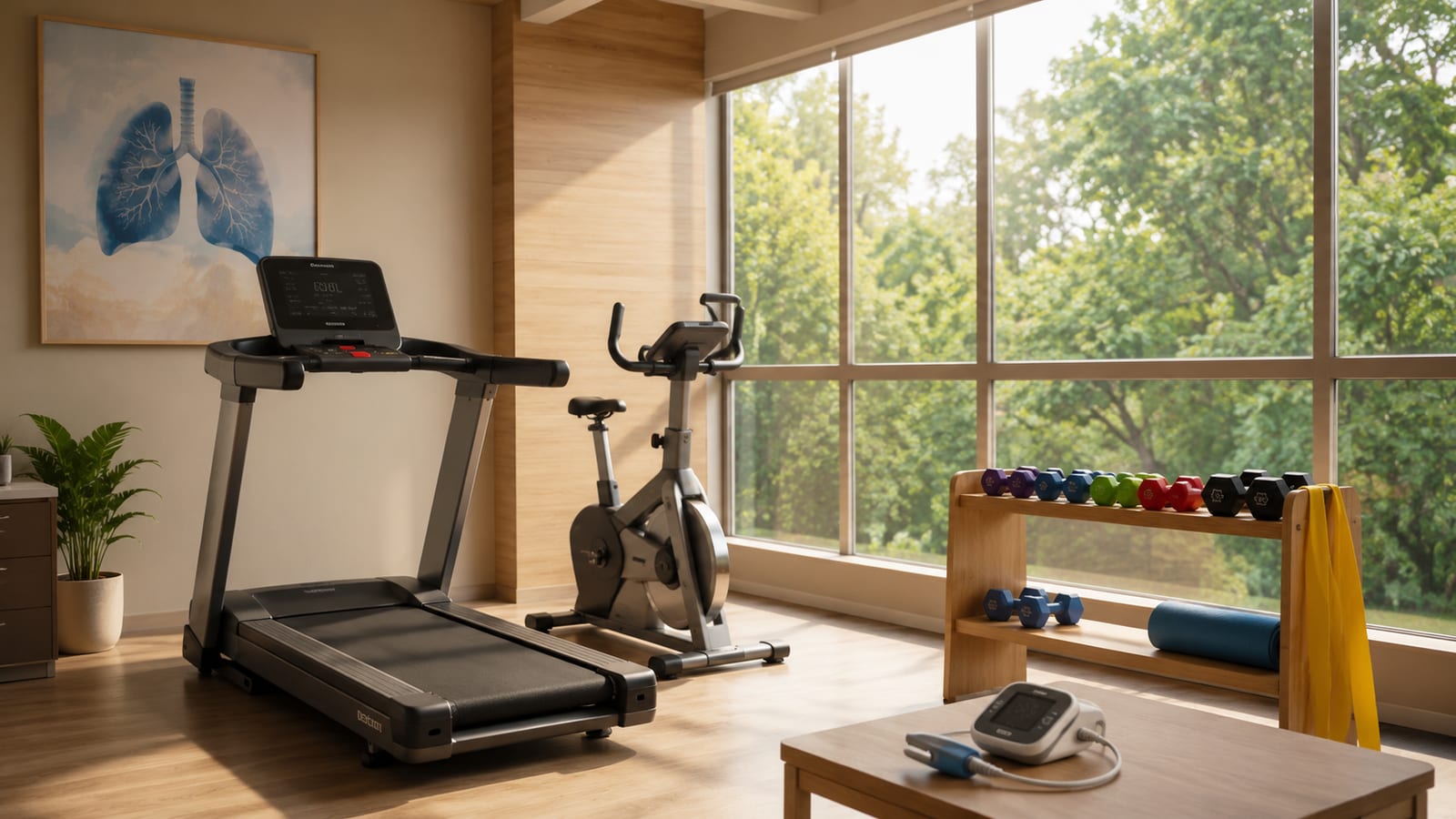
Structured pulmonary rehab starts at week 4. Three or four supervised sessions per week for 8–12 weeks: aerobic conditioning on a treadmill or stationary bike, resistance training for the arms and legs (small weights, gradually building), breathing pattern training, and education sessions on medication, symptoms and lifestyle. In my practice, pulmonary rehab is not optional - it is one of the highest-impact interventions we offer, and published rehabilitation studies consistently show meaningful gains in exercise capacity and quality-of-life measures for patients who complete a structured programme.
Immunosuppression settling
Steroid (prednisolone) doses are actively tapered even before discharge from hospital - a typical taper is 20 mg → 10 mg → 5 mg per day, with the exact pace decided by the transplant pulmonologist based on the individual’s clinical status. After discharge, in months 1–3, the dose continues to be trimmed and adjusted based on clinical review. Tacrolimus doses are titrated against target trough levels throughout. Side effects - facial fullness, weight gain, insomnia, high blood sugar, mood swings - are common at the higher initial doses and improve as the taper continues. We watch for too aggressive a taper too, because that can trigger rejection. This is the balance we manage each visit.
Early infection risk
Cytomegalovirus (CMV), Pneumocystis jirovecii and Aspergillus are the three infection risks we watch for most carefully. All three are managed with prophylactic medication in the first 12–18 months, adjusted based on periodic monitoring and individual risk factors. Any breach of infection precautions - hot street food, an unwell family member visiting, a large indoor gathering - is worth reporting so we can watch more closely.
When can you return to normal life?
This is when most patients start to feel meaningfully like themselves. Weight begins to redistribute, steroid side effects ease, exercise capacity climbs steadily, and psychological recovery begins to catch up with physical recovery.
Return to work
Desk-based, remote or hybrid work typically resumes at month 3–4 - part-time first, then full-time by month 6. Physically demanding work needs more time and often more adaptation. Discussion with the transplant team about work environment (crowded office, air-conditioned commute, exposure to construction dust or agricultural work) is essential and specific to each occupation.
Driving
Driving typically resumes at month 2–3 in an urban setting - after we confirm your chest wall strength allows safe use of a seatbelt, your reaction time is normal off high-dose steroids, and your eyesight (which can be affected by steroids) has been re-checked.
Sexual health and intimacy
A topic that patients rarely bring up but always want to know about. Sexual activity is safe from month 2–3 onwards. Libido may take longer to recover due to steroids and general post-operative fatigue - this improves as doses reduce. Contraception is important in the first 2 years for female recipients because pregnancy on tacrolimus needs specialist pre-pregnancy planning - it is not contraindicated permanently, but requires managed medication changes and involves a specialist obstetric team.
What does the first year after transplant look like?
By month 6, most patients are living what they would call a normal life. The remaining six months are about consolidation - confirming the graft is stable, keeping surveillance up, and quietly preparing for the transition to year-two care.
The 6-month bronchoscopy
Around month 6, a scheduled surveillance bronchoscopy checks for silent rejection, examines the anastomosis for late narrowing, and takes cultures for chronic colonisation (Pseudomonas, Aspergillus). If everything is stable, further surveillance bronchoscopies drop to annual or on-demand only.
Vaccinations
From month 6, we start reintroducing vaccinations - only non-live vaccines. Annual influenza, pneumococcal, and updated COVID vaccines are routine. Live vaccines (yellow fever, MMR, oral polio, varicella) are permanently avoided.
The one-year milestone
Reaching one year post-transplant is a real milestone. Statistically, patients who reach year one have a much lower risk of graft loss going forward. Doses are usually at their lowest settled level. Follow-up drops from monthly to quarterly. Most recipients are back to full activity.
Common recovery milestones - the timeline table
Below is the milestone table I share with families during the pre-transplant conversation - so they know exactly what to expect at each stage. Individual timing varies with age, comorbidities and complications, but this is the typical range at a high-volume programme.
| Milestone | Typical timing | What we look for |
|---|---|---|
| Extubation from ventilator | 24–48 hours | Adequate gas exchange, alert and cooperative, no acute rejection signs |
| Sitting up out of bed | Day 2–3 | Haemodynamic stability, chest tube drainage settled |
| First assisted walk | Day 3–5 | Muscle strength adequate for weight bearing |
| Chest tubes removed | Day 5–7 | Drainage < 100 ml over 24 hrs, no air leak |
| Discharge from ICU to ward | Day 10–14 | No ventilator support, stable oral immunosuppression, no active infection |
| Discharge home | Day 14–21 | Walking independently, tolerating diet, therapeutic drug levels |
| First surveillance bronchoscopy | Week 2–4 | Rejection screening, anastomosis inspection, secretion cultures |
| Pulmonary rehabilitation starts | Week 4 | Sufficient wound healing, cleared for supervised exercise |
| Walking 500 metres unaided | Month 2 | Cardiopulmonary recovery, resting SpO₂ > 95 % |
| Steroid dose halved | Month 3 | No acute rejection, stable graft function |
| Return to desk work | Month 3–4 | Doses stable, no infection, cognitive recovery from steroids |
| Return to gym-level exercise | Month 6 | Rehab programme completed, cleared by transplant team |
| International travel | Month 6–9 | Stable doses, vaccinations updated, travel plan reviewed |
| 1-year survival milestone | Month 12 | ~85 % globally per ISHLT registry; high-volume centres typically upper-end |
| 5-year survival milestone | Year 5 | ~55 % globally per ISHLT registry; CLAD is the main threat |
Indicative timing for a straightforward bilateral transplant at a high-volume centre. Individual timelines vary; the transplant team’s written plan is the definitive schedule for your case.
The milestones you hit in the first month predict the whole first year. Fast extubation, early mobilisation and a clean first bronchoscopy are the three markers that reassure me the graft has settled well.
What warning signs mean you should call the team?
Learning to read your own body after transplant is one of the most important skills of the first year. In Dr. Manjunath M Negigoudara’s post-transplant practice at KIMS Electronic City, rejection and infection are the two threats we watch for constantly - both are usually reversible if caught early. Below are the signs that warrant a same-day call to the transplant team.
Call the same day for
- New or increasing breathlessness at rest or on minimal exertion
- Fall in home spirometry FEV1 > 10 % from your baseline over 2–3 days
- New persistent cough lasting more than 24 hours - even without a cough reflex, cough can develop from tracheal irritation
- Fever above 38 °C without other explanation
- Chest pain, especially sharp, positional or worsening
- Unexplained tiredness or an abrupt drop in exercise capacity
- New sputum that is discoloured, blood-stained or foul-smelling
- Focal chest infection signs - localised crackles or wheeze
- Weight gain > 2 kg in a week (may indicate fluid retention)
- New peripheral swelling or new headaches
Go to the ER (or call 108) for
- Severe breathlessness at rest, unable to complete sentences
- Chest pain with radiation, sweating or nausea
- Coughing up blood - more than a teaspoon
- New confusion, weakness or slurred speech
- SpO₂ on your home pulse oximeter < 90 % at rest
- Any sign of anaphylaxis, especially after a new medication
What is the long-term outlook after a lung transplant?
Once you cross the one-year milestone, the character of care changes. Follow-up drops from monthly to quarterly to annual. Immunosuppression settles at the lowest effective dose. Most recipients live active, engaged lives with the normal responsibilities of family, work and community. The main long-term threat we watch for is chronic rejection.
Current survival benchmarks (per ISHLT registry)
Per the ISHLT International Thoracic Organ Transplant Registry - the largest global registry of lung transplant outcomes - published median survival across all indications and adult recipients is approximately:
- 1-year survival: ~85 %
- 3-year survival: ~65 %
- 5-year survival: ~55 %
- 10-year survival: ~32 %
These are pooled global averages. Individual outlook depends on age at transplant, whether it is single or bilateral (bilateral is typically better long-term), underlying disease, freedom from CLAD, and access to specialist follow-up care. High-volume programmes tend to report outcomes at the upper end of these ranges. In my practice at KIMS Hospital, Electronic City, we track our own programme outcomes against these registry benchmarks at every annual review.
Chronic Lung Allograft Dysfunction (CLAD)
CLAD is the umbrella term for progressive decline of graft function due to chronic rejection. The two main subtypes are Bronchiolitis Obliterans Syndrome (BOS - the more common) and Restrictive Allograft Syndrome (RAS). CLAD typically appears from year 2 onwards and is the main reason 5-year survival is lower than 1-year survival.
Dr. Manjunath M Negigoudara and the KIMS Electronic City team watch for CLAD by tracking home spirometry (FEV1 falls of > 20 % from baseline are a red flag), annual HRCT and clinical review. Early CLAD may respond to switches in immunosuppression protocol, azithromycin, or extracorporeal photopheresis at specialist centres. Advanced CLAD can be treated with retransplantation in selected patients - I presented India’s first successful redo double-lung transplant at the European Society for Organ Transplantation (ESOT) Congress in London in 2025.
Living well - the practical India-specific guide
The clinical topics above cover the medical side. The practical side is what patients ask me about most - what does daily life actually look like after transplant, especially in the Indian context. Here is the honest guide.
Diet and food safety
The Indian food environment is friendlier to transplant patients than many international ones because so much of our food is freshly cooked at high heat. In the first 3–6 months, follow food-safety-first rules:
- Yes: Freshly cooked, hot Indian food - dals, sabzis, chapatis, rice preparations, well-cooked eggs, fresh dairy from packaged brands
- Wait 3–6 months: Salads, uncut fruit outside home, restaurant cold dishes, raw seafood, buffet food, leftovers older than 24 hours
- Avoid indefinitely: Street food from vendors, chaat, cut fruit from vendors, raw sprouts, soft cheeses, unpasteurised milk, undercooked meat, alcohol in the first year
Exercise and sport
Walking daily is protective and safe from discharge onwards. Structured gym work, running, swimming and yoga can resume at month 6 with team clearance. Contact sports (boxing, rugby, martial arts) and heavy weightlifting are usually permanently avoided because chest trauma is a real risk to the graft. Most recreational sports - cricket at social level, tennis, cycling, badminton - are safe and encouraged.
Monsoon and mould
The Indian monsoon deserves particular attention. High humidity increases the risk of aspergillus and mould exposure - two of the most dangerous infections for a transplant lung. In the first year specifically:
- Avoid old buildings with visible damp or mould
- Do not enter waterlogged rooms or basements
- Avoid gardening and turning compost during monsoon months
- Dehumidify the bedroom if humidity stays above 65 %
- Report any new breathlessness or fever during monsoon season the same day
Work environment
Desk-based indoor work is fine from month 3–4. Manual labour, construction work, agricultural work with soil exposure, teaching that involves large classroom groups with frequent seasonal infections, and healthcare work in high-risk wards each need individualised discussion with the transplant team. Many recipients successfully return to their original occupation with small adaptations - masking during flu season, avoiding high-risk exposures, and taking sick leave promptly for any respiratory symptom.
Travel
Domestic travel resumes at month 3–4, international at month 6–9. Always travel with a week’s extra medication, a printed medication list in English, and the transplant team’s contact details. Long flights are safe on stable immunosuppression. Avoid destinations with active outbreaks (yellow fever regions where the vaccine cannot be given, dengue or chikungunya hotspots) in the first two years.
Family, community and mental health
Recovery is easier in a household that adapts alongside the recipient. The first six months can feel isolating - visitors are limited, activities are curtailed, and steroid side effects can affect mood. This is temporary and improves as doses come down. Encouraging the recipient to reconnect with friends, resume small social activities, and speak openly about mental health with the team is important. Post-transplant depression is common in the first year and eminently treatable when reported.
How often is follow-up after a lung transplant?
Your relationship with the transplant team is a long one. Below is the typical follow-up cadence that Dr. Manjunath M Negigoudara uses at KIMS Hospital, Electronic City for a stable, uncomplicated recipient:
- Month 1–3: Weekly clinic visit, twice-weekly drug-level monitoring
- Month 3–6: Every 2 weeks, then monthly
- Month 6–12: Monthly
- Year 2: Every 2–3 months
- Year 3 onwards: Quarterly or bi-annually if fully stable
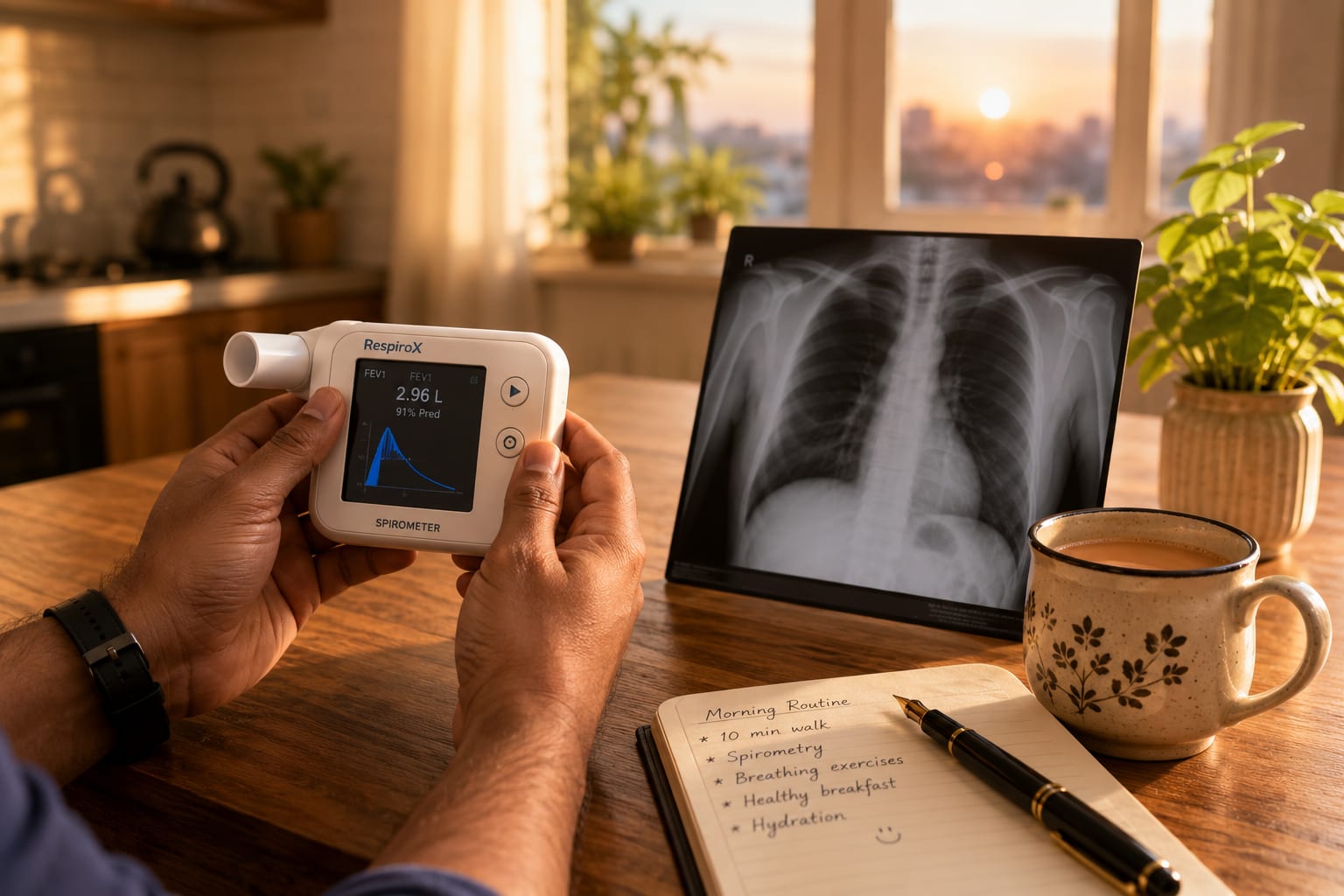
Surveillance bronchoscopy: at 2–4 weeks, 3 months, 6 months, 12 months, then annual or on-demand only. Home spirometry (a small handheld device) is highly recommended - it lets us detect subtle FEV1 decline weeks before symptoms appear.
Related reading: our lung transplantation programme · Who needs a lung transplant? · Lung transplant cost in India · ECMO as bridge to recovery vs transplant · Post lung transplant airway interventions
Frequently asked questions
What is life really like after a lung transplant?
How long is the recovery after a lung transplant?
Can I return to work after a lung transplant?
When can I start exercising after a lung transplant?
What is the survival rate after a lung transplant?
How often will I need bronchoscopy after transplant?
What are the warning signs of lung transplant rejection I should watch for?
What can I eat after a lung transplant?
Can I travel after a lung transplant, including on aeroplanes?
Medical disclaimer. This article is general information from Dr. Manjunath M Negigoudara’s clinical practice. It is not a substitute for an individual consultation. For specific advice about your condition, please schedule a consultation. For emergencies, call 108 (India) or go to your nearest emergency department.
Have a question about your case?
Talk directly with Dr. Manjunath M Negigoudara.
Consultations, second opinions and referrals are welcomed by phone or WhatsApp. Mon - Sat, 9am - 5pm at KIMS Electronic City.